
One of the ways ardent seekers would try to pierce the veil into the spiritual reality, especially during the Middle Ages, was to carefully observe and deeply contemplate the natural world around them. By this I mean going beyond what was given, what did not need to be worked for, within sense perception. Things were easier on this front 1200 years ago in Europe because relatively little had been done to the landscape through human industry by way of concealing how nature operates in the world. There is a lot more distraction now within our sensory inputs. (The obvious example requiring no effort whatosever to uncover is how difficult it has become to gaze at the starry heavens from where most of the world’s population resides.) On the other hand we do have some counterbalancing forces of an intellectual quality at our disposal which were generally unknown back then. Scientific researches and instruments, academic trainings, libraries… But all of these complex nets of thoughts carry their own capacity to distract us from pure phenomenological observation, without bias.
In the late ’70s or early ’80s I came across some research results by a pair of Rutgers naturalists. They published exhaustive data around years of detailed observations and measurements, and proposed a radical new solution to a problem most people failed to even imagine the existence of. Their idea was: Let the prarie lands of the American midwest go back to being undeveloped; let it return to a vast rolling grassland. Nebraska, Iowa, Kansas, parts of the Dakotas, Oklahoma, maybe parts of Missouri, eastern Colorado. Of course they had gradual phases outlined; they knew full well how much outcry this idea would engender. Their data showed how the buffalo would return, the American Bison herds. How soil quality and weather patterns would ameliorate due to the eventual elimination of vast swaths of planted monocultures, like corn, wheat, and soy and cattle farming, which they showed to be incredibly non-cost-effective in terms of nutrition production. They also outlined plans for a relatively painless shifting of current midwest populations out of the area. (This population, as they predicted, would gradually diminish over time anyway due to the harshening of the climate and the reduction of economic opportunity.) Their researches addressed how economic displacements from cattle grazing and monoculture farming could be absorbed in other adjacent healthier ways. Not residing in the midwest, and being partial to impossibly romantic and idealistic undertakings, I was onboard with the proposal. I’d read about the disappeared native American Plains culture and thought it must have been something like paradise. Ecology was becoming an academic discipline, outgrowing its countercultural toddlerhood. America and the West could well afford to reverse its pathological addiction to cheap plentiful beef, which is hard to digest in massive quantities without compromising colon health and which besides this, was heavily subsidized in effect because nobody was taking into account the ecological costs to the landscape. There would also not be anything like the ‘Dust Bowl’ incidents of the previous century if the praries returned, as it would prevent erosion.
But since the evident demise of that hare-brained scheme I’ve drawn my care for the planet optimisms from more modest efforts. Attitudes towards natural resource exploitation vary wildly by geographic location. And wherever powerful money has entered the picture, increasingly everywhere, the sensitivity to the delicate interwoven balance between species of all types and weather and landscape has been treated as financially irresponsible stupidity. Still, there is an inherent intelligence within the intricate weaving of natural processes on the Earth. And without wishing to debate the origins of this apparent intelligence, it is easy to see how humanity’s single-minded, short-term ethos, limited focus interventions in the natural order of things have generated climate disasters and species extinctions, in a way that has been completely unanticipated and chaotic. The notion of legal Environmental Impact Studies wither away swiftly in the face of economic greed. That’s why it was pleasant and surprising to come across a recent news story from my neck of the woods, Quebec, showing how some locales still do try to keep mindful about the impact of onrushing human ambitions, and demonstrate the political will to enforce measures.
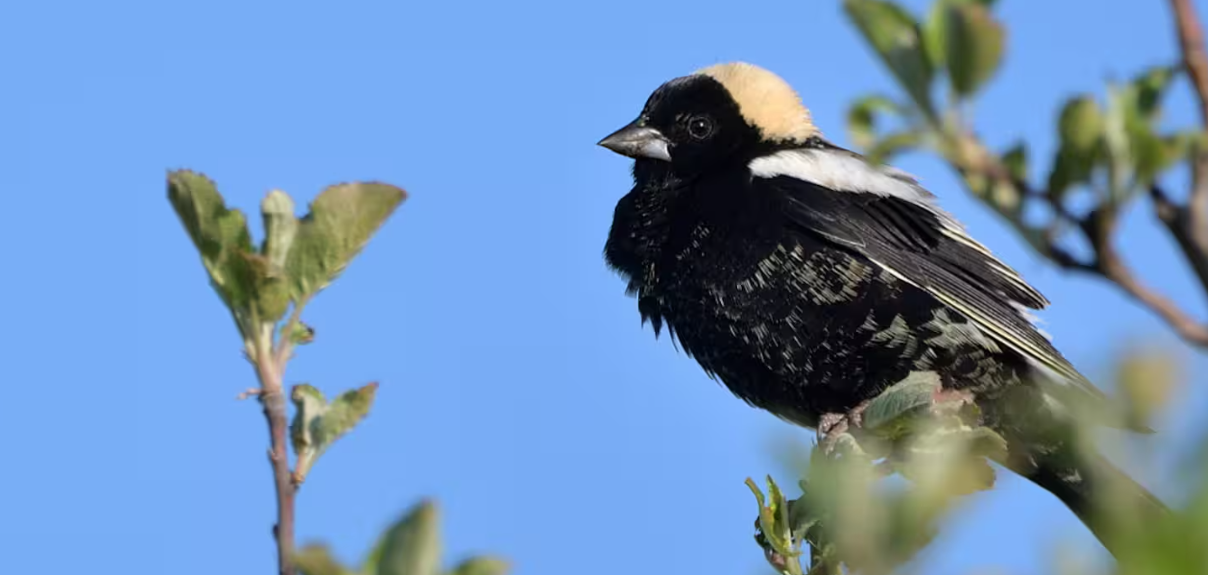
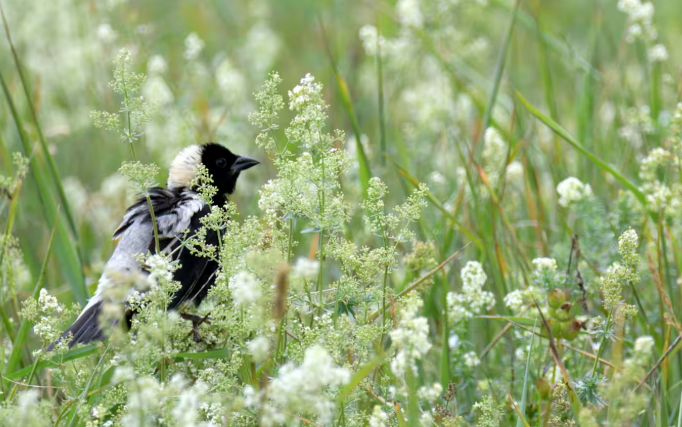
Since the article is in French, I’ll spell out the gist of it. There is a kind of bird called a bobolink, shown in the nice photo above. One of my very favorites from the days long ago when I used to delve into species of wildlife and wildflowers and nature in general. Already when I became interested, the bobolink was becoming unusual in the northeast. In fact I only ever saw one in the wild once. The reason for this was habitat destruction. Boblinks fly from central and south America in May and build nests in tall grasses, ample enough amounts of them so as to constitute a field, and feed their young and themselves on a variety of seeds from tall grasses and “weeds” along with some insects which enjoy the same environments. The tall grasses give not only food but concealment, and bobolinks make their nests right on the ground. By early July, most bobolink broods have left their nesting grounds and graduated to a diet heavier in insects. Their reliance upon the tall grasses diminishes. But for a small window of four to six weeks it is crucial. The second photo, just below, captures this beautiful bird, which is smaller than a cardinal but maybe slightly larger than a sparrow, camouflaged at the height of nesting and feeding season amidst blossoming tall wildflowers.
Wildlife biologists, and botanists and various legal political types recognized these details and got together to design and pass a law, for southern Quebec at least, stipulating that no mowing of these large grasslands can occur until late June or early July, allowing the bobolink generation to pass safely into the summer. Not only are the resulting fields delightfully beautiful as compared to industrially mowed flatlands, but species of flora and fauna are preserved. What the article describes is how a township apologized and agreed to pay a $30,000$ fine because an enforcer was able to find a single destroyed bobolink nest, eggshells included, within the flattened grasses of a too early cut down wild field. That is correct — they apologized. Felt bad! It might well be the case that more than one nest and bird family was obliterated, but all that was needed to enforce the fine was the demonstrating of one crumbled nest.
I know that this sort of thing will wrankle the libertarian-streaked and business-first among us, and have others roundly cursing out tree-huggers, but this news simply made my day. Bobolinks, by the way, are largely an eastern bird, and distinctly American. Ornithologists guess there are about 10 million of these birds alive at present, which sounds like plenty. They are endangered however, because their population is estimated to have declined about 70% since only forty years ago, due to habitat loss, multiple hay harvests per season, and agricultural pesticides. The situation is slightly worse in Canada than the U.S. but America is catching up. Grasslands are magical places, delightful phenomena. Think of Andrew Wyeth’s evocative mid 20th century painting “Christina’s World”. In parting I thought I’d include a photo of an equally lovely midwestern prarie bird which has also begun to decline due to habitat destruction, the meadowlark. It does better in conventional farmlands and rural settings, and so has better options than the bobolink species… so far. If you compare the beak shapes of these two birds, it can be seen that the one is specialized for cracking small seeds and collecting smaller insects, while the other is adapted for grabbing larger insects, and worms and grasshoppers.

_______RS
Notes : Bobolinks make delightfully intricate yet sweet vocalizations. Wanna hear?
► Handy INDEX — scan through all available ||SWR|| articles
 ||skirmishes|| ||with|| ||reality||
A lovely, hopeful, and heartwarming story, Rob. I remember the songs of the bobolink from my childhood in a small northeast New Jersey town. From pictures of my old neighborhood online, it appears that the woods, ponds, and fields are long gone now, with every inch filled with concrete, roads, and houses.
Wow, Carol. I did not know of them in childhood. My northeast NJ town was called Lake Hiawatha, and truly it was mostly farms and a small village at first, when I was 5 and beginning to cognize. By the time I was a teen, a high school occupied one farm field, and interstate 80 which was to connect all the way to the Pacific Ocean passed through the area close by and intersected another new interstate running north and south. This was the beginning of Parsippany which expanded quickly. I had to travel in my 20s south and west to a place called the Great Swamp (itself narrowly escaping preservation as it almost became an international airport) to find a bobolink — and many other things of worth. 🙂 Thanks for writing.
I lived a bit east and north of you in NJ, in Allendale, until I finished 7th grade. I just visited via the internet. It still seems a bit away from major highways,. It was like a wonderland to me when I was little — with woods, a brook, and a pond where I could gather jars of water with microscopic plants and animals I could view and pollywogs. And I do remember the call of the bobolink, although I haven’t heard once since I moved. Your story brought back the memory, though. Thank you for sharing this wonderful history and story.
You were near the NY state line then. yes — pollywogs… always hard to believe from the looks of them they would be frogs one day! welcome, Carol, welcome.
Excellent piece on nature and evolving habitats. Awareness of the climate causing damage to nature and our own species needs many more articles like this! Thank you for sharing your hopes with us as they are the same for many of us. I wish I could be as optimistic as you about humanity’s willingness to restore the beauty and purity of our air and planet.