
University life, in America, actually used to be about rampant curiosity once. And the opposite sex. Not too much at all really, about jobs or money. Parents didn’t know this. Bless their forever selfless hearts…

Close your eyes, figuratively. If I ask you to picture the word green, do you imagine this or perhaps this, or something closer to this? How does your typical green image differ from mine or that of your daughter or a business colleague who lives in Costa Rica? Assuming we could develop a statistical norm for what speakers of American English generally mean by the word (and some studies have tackled this question), it only opens the door to further more interesting psycholinguistic puzzles. For example: has the concept ‘green’ changed subtly since the days of Thomas Jefferson, Shakespeare, or William the Conqueror? Do children conceive ‘green’ differently than senior citizens (perhaps even the same individual at different ages)? How does this compare with a Brazilian person who is thinking of verde? Or a Mongolian pondering ногоон?
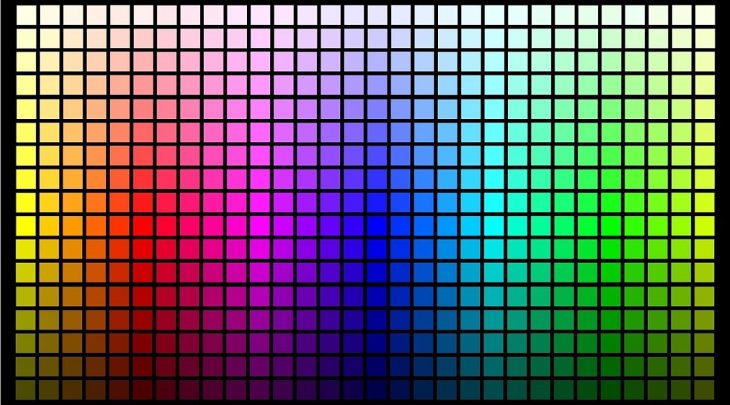
In 1969, a kind of landmark book came out by researchers Brent Berlin and Paul Kay with a title that belied it’s intriguing content, Basic Color Terms. The publication opened up a whole new line of inquiry within related fields of language and thought. In fact it’s been quite fruitful as an incubator of research; Kay is still at it nearly fifty years hence at Berkeley. It also found it’s way off the library shelf and into my fascinated hands for several months although it had absolutely nothing to do with anything else going on in my life at the time — a fairly commonplace sort of diversion for me in those days. It came with a wonderful foldout with hundreds of contiguous color squares arranged spatially, and the text suggested various cognitive-linguistic experiments you could try out on your perhaps less patient than you imagined friends.
A Tour of Color in English
How many colors are there? From varying points of view the question can seem either childish or absorbing. The 20th century philosopher Wilfrid Sellars distinguished the manifest and scientific images when considering world reality. The manifest image has to do with how matters directly seem inwardly as a result of sensory perceptions and everyday conceptual observations. The scientific image, which has developed and become dominant since the early 17th century, focuses upon that vast body of technical and theoretical knowledge which has proceeded from applying the scientific method to an analysis of world phenomena. In particular, it minimizes purely sensory impression and treats anything mental, inward, or subjective as anathema. The proper depiction of color in keeping with the scientific image would be the color spectrum, as elucidated within physics. Names associated with specific wavelengths are superfluous, only the quantity of nanometers matter. (Specifically from about 370nm to 740nm, a slim range sandwiched between the ultraviolet and infrared wavelengths.) In fact, the ideal scientific representation would have no use for the visual color representation at all — it is merely included for convenience, and considered a side effect of human constitution and evolution. (If you dig playing around with wavelengths and colors, here is a pretty cool tool to check out.)

What we are exploring here is neither manifest nor scientific image per se, but rather language referent, which is something hybrid living in the realm of thought. Still, our language and speech behavior is much more heavily influenced by the manifest image. In both our personal development, beginning as children, and in historical cultural development we see a fundamental attachment to what has been visually perceived. There are no high-frequency lexical terms for things like ‘wavelength’ or ‘visible spectrum’.
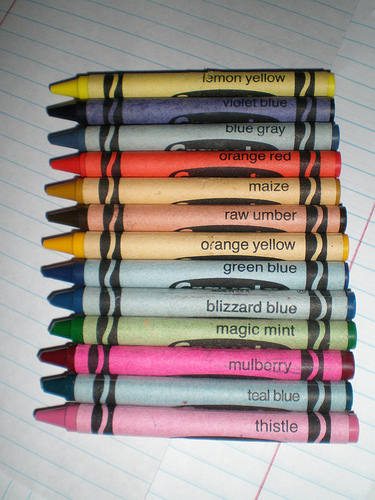
As young children we are first exposed to very simple color vocabulary. Ambient adults do not expose us initially to lavender and turquoise unless they’re peculiar or insensitively pedantic. We usually learn the difference between black and white very early, and then soon pick up words for basic natural colors evident around us. Our earliest coloring sets, often crayons, contain the same well-known six or eight colors. When a little older we might be taught that there are considered to be three primary colors, red, blue and yellow, any two of which can be mixed together to produce the three secondary colors, green, orange, and purple. We might see this depicted as a basic color wheel. The English-speaking child aged five will typically know the words for these colors and also for a few others, and they will be able to produce the word when describing the appropriate seen color. I can still recall the ascending sequence of boxed Crayola crayon sets in their lineup: 8, 16, 24, 48, and 64. (I’ve since learned that well after my childhood Crayola produced a massive boxset of 120 different crayon colors.) But fascinating as these new color names were, none were exactly common. I knew that not all children or even adults would carry the same conceptions of what color names like mahogany and vermillion meant, or even share the awareness that the terms existed. If you were a Crayola enthusiast you might learn the jargon, or not, simply electing to color with them. Similarly, people who obsess over interior decorating or fashion catalogs might become familiar with the numerous variations of beige the Sherwin-Williams paint company ad copy team would seasonally devise: eggshell, almond, taupe, mushroom, morning mist, linen, antique white, soft ice, vanilla cream, sponge. Or care that the latest happening fall overcoat colors are autumn blaze and butternut squash. But the referents for these usually ad-hoc English words would be agreed upon by virtually no one.
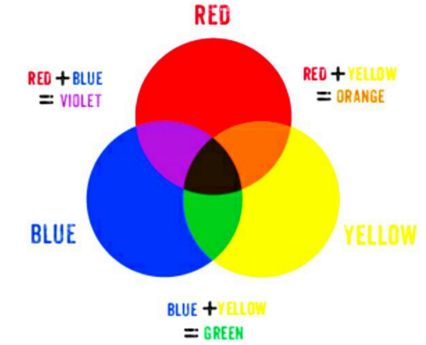


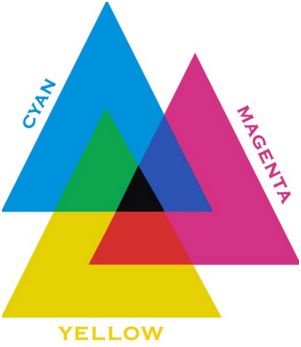
Artists too have cared about color gradations down to subtle shade distinctions and often derived their inspirations from natural phenomena. As the scientific temperament increased, more attempts were made to systematize long possessed color expertise. More than a century after Newton, Goethe assembled an optical laboratory and many prisms, studied light phenomena, wrote treatises, and painted color wheel diagrams. Responding to a growing sense that the systematic illustration of colors needed more depth than a simple color wheel, Moses Harris created an influential color chart in 1785 with concentric rings intended to depict not just hue, but saturation intensity and lightness or darkness. This led to more modern attempts to use 3-dimensional curved surfaces to depict all possible colors. With the advent of computers and rampant digitization, techniques for describing colors as precisely as possible with sets of numeric coordinates, as well as ways to produce colored pixels on monitors via the measured combining of three base components have arrived. This last technique is known as CYM imaging because the three base colors used are termed cyan, yellow and magenta. Digital cameras use RGB filters instead (red/green/blue) because this triplet can more accurately produce a wider palette of hues while sacrificing a bit of brightness. Finally, I’ll mention a very nicely done webpage, a true labor of love, which guides you through an historical overview of many techniques and developments in color production methods, interestingly enough from the vantage point of postcards.



What Are ‘Basic Color Terms’?
A key concept which Berlin and Kay introduced so as to experimentally access the questions which interested them was the Basic Color Term (BCT). The idea was to consider only simple, pure, vocabulary items within and across languages referring to perceived colors. Red was okay, but things like magenta, crimson, watermelon, scarlet, pomegranate, and red-orange were deemed too subjective, explicit, or unable to evoke a convincing consensus among speakers to be considered. They also wanted to avoid compound or descriptive color names such as burnt sienna, mustard yellow, lime green, or lapis lazuli. So we have the notions of broad semantic consensus, lexical simplicity, and association strictly with color instead of other kinds of objects bearing particular colors. Berlin and Kay distilled the definitional linguistic requirements for BCTs as follows:
wide consensus1 – agreed upon by speakers of that language
monolexemic – one word, not a term built of two words
high frequency – best signal for this is normal inclusion in a 5-year-old’s vocabulary
A few other points may be added to these criteria in order to clarify one’s understanding: All other color words (non-BCTs) are considered by most mature speakers of the language in question to be variants of one of these basic color terms. Thus emerald is a variant of green. Also, a proposed color term cannot be limited in common speech to a narrow class of objects. An example of this is blonde in English, which only really applies to hair color or sometimes to wood/varnish color. It turns out that English contains exactly 11 BCTs. And so do most modern languages, including European ones. Before continuing it might interest you to pause and attempt to call to mind what you think these eleven English color words are …


[ Blonde actress Abbie Cornish (source); Blonde-stained wooden flooring; Contemporary box of Crayola’s 8 basic crayons; Airliner passing a pregnant sky’s rainbow. ]
Of course the three primary and three secondary colors (blends of the primaries) must be included. Black and brown are also among the English BCTs, which accounts for the entirety of the original boxed set of 8 Crayola crayons, first offered by the Smith & Birney company in 1903. Added to these are white, grey, and finally pink (perhaps a bit of a surprise to some people, but studies confirm that the three criteria hold for pink in English.) This gives the English BCT-set as: red blue yellow green orange purple white black brown grey pink.
Keep in mind, for later discussion, that these common words for colors do not necessarily imply anything about neurological or perceptual capabilities of a language community. They only characterize for the moment the commonality and frequency of speech habits.
Russian Blue and Evolving Refinement
Berlin and Kay enunciated a methodical field discovery protocol for determining the BCT set of a given language and their original study collated initial comparative results for twenty different world languages. It is generally agreed among professional linguists that world languages all contain between 2 and 12 basic color terms. This range may strike you as unexpected for two different reasons. On the low end we can marvel at how a community of speakers for a given language can get by with such a limited set of basic color terms. Dani, spoken in the highlands of Papua New Guinea is one such langauage. On the high end we can wonder how and why a certain language could possibly eclipse our beloved English in the richness of BCTs. To ask why is to open a Pandora’s box of psycholinguistic, cultural, and epistemological puzzles beyond the scope of this article. As to the how (or the what), the most commonly cited example is Russian which distinguishes, at a BCT level, between dark blue and light blue. The Russian words are синий (siniy) and голубой (goluboy) respectively. Think what this means. The average Russian 5-year-old knows both words equally well and does not prefer to collapse either term into the other when talking about colors. Adults consider them as basic, and not variants of one another. There is no generic Russian word for ‘blue’! Russians describe the foci of these two color terms as the pale blue (goluboy) of the sky, like azure, contrasted with the deep blue (siniy) of the sea. As a further bit of evidence, I located a Russian language learning website which contains a lesson concerning everyday colors, and sure enough there are twelve words mentioned. Here are a couple of telling quotes from a 2007 study which probed more deeply into the matter of Russian blues, explicated in the journal Nature:
“The critical difference in this case is not that English speakers cannot distinguish between light and dark blues, but rather that Russian speakers cannot avoid distinguishing them: they must do so to speak Russian in a conventional manner.”
“Russian is a very interesting test case,” comments Angela Brown, who studies colour perception at Ohio State University in Columbus. “Only around 5% of languages make a necessary distinction between light and dark blue”, she says.
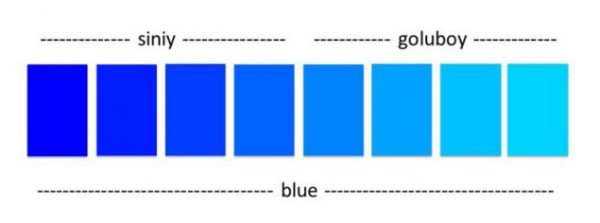
To be fair, Russian, possessing 12 BCTs, does not solely comprise the pinnacle of color refinement when surveying world languages. Some have argued the same distinctions are true for both Modern Hebrew and Modern Greek. In Hebrew, תכלת (tchelet) signifies light blue which is basic and differentiated from כחול (kachol) signifying dark blue. In Modern Greek, γαλάζιο (galazio) means light blue, while the word μπλε (ble), pronounced similarly to English ‘blue’ and an obvious cognate, signifies blue. There may be a slightly weaker semantic referent BCT case for the Greek; I’d need to research further. (It would also be interesting to know whether there is a distant lexemic cognate relationship between the Greek galazio and Russian goluboy.) Note that the names of these languages are prefaced by the term ‘modern’ for slightly different reasons. Contemporary Hebrew is initially a reconstructed language, having lacked native speakers for more than 1000 years, although now it clearly is thriving and displays a vivid literary and conversational life. There was a hiatus in the life of Hebrew between Biblical times and 1920, during which it gradually assumed a strictly liturgical and scholarly character, until Eliezer Ben-Yehuda crowned the revival effort for spoken Hebrew which had been percolating within European Jewish culture for about half a century. I do not believe there is any evidence that ancient Hebrew had two basic ‘blue’ color terms. Contemporary Greek is called modern to distinguish it from classical Greek which is still a popular object of academic study due to the wealth of ancient literature available and Greek’s influential position within the development of Western civilization. Unlike with Hebrew however, there is not an historical hiatus between old and new Greek, just a continuous linguistic evolution gradually rendering the two mutually unintelligible after 2500 years.
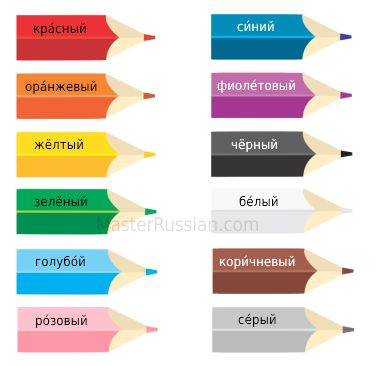

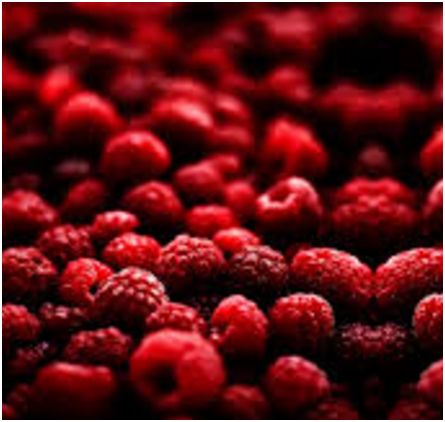

[ Pictorial from a Russian For Foreigners language lesson on color vocabulary showing the 12 basic colors; Sea and sky illustrating the two basic Russian blues; Wonderfully colored dark red wild raspberries; Ad for vörös-colored hair in a Hungarian beauty salon. ]
Some linguists also champion Hungarian as a 12-BCT language since it makes a basic distinction between dark red and ordinary red. This is different than the distinction between red and pink, the word for pink also being basic in Hungarian. The words are piros and vörös, but the claim is complicated by a semantic issue because in Hungarian piros is normally applied to inanimate or unemotive objects (the rich red of paprika for instance) while vörös is used for animate or emotive objects (an example being the auburn of a woman’s hair.) Irish (Gaelic) may also have a distinction between dark red and ordinary red: ruadh and dearg, but this is another language whose history is complicated by near extinction last century and a well-organized revival movement. I do not know whether there have been any formal confirming studies of this at the BCT level. It’s interesting to speculate about a linguistic evolutionary tendency to distinguish between lighter and darker varieties of what had previously been considered a unified color category, i.e. red or blue. It is supposed that this is somehow the way pink branched off from red historically within 11-BCT languages. Could deep forest green versus spring willow green be next as a basic distinction a few centuries in the future?
Seven Stepwise Stages?
A most interesting and somewhat controversial proposal resulting from the findings of the 1969 Berlin-Kay study is that natural languages pass through specific ordered stages of development regarding color vocabulary. Paul Kay has been partly occupied with defending this idea from criticism up until the present day, although there have been modifications and qualifications along the way. If you wish to track some of this ongoing debate, this PDF provides a good starting overview of the claims and rebuttals since 1969.

The progression holds that if a language has only 2 BCTs, in other words stage I, they will invariably correspond to our words for black and white, although dark versus light are probably better synonyms. Kay has since published updates to his theory, backed by studies, which group actual world color referents like yellow, light blues, white, and pastels within the color term light while placing the rest like browns and dark greens and reds within dark. This has been driven by field studies of aboriginal languages; the Dani example from Papua New Guinea has already been mentioned as a 2-BCT language. Some semantic associations within Dani suggest that warm and cool2 might better describe the opposing color terms. Within Dani, the two basic color terms are mola and mili.

The second stage are 3-BCT languages, and Kay’s claim is that when a third color term appears it will always be red. The stages continue in a nested fashion. Yellow and green or some variant color term will always occur next: in 4-BCT languages there will be a word which signifies one or the other or something in between these two, and all 5-BCT languages will contain both of these colors before developing other new color terms. An example of a 4-BCT language is Himba spoken in the northern deserts of Namibia. It’s color terms are zuzu meaning dark shades of blue, red, green and purple; vapa meaning white and some light shades of yellow; buru comprising some shades of green and blue; and dambu signifying leftover other shades of green, red and brown. Blue and brown per se are added at stages V and VI, and the final four colors comprising the 11-BCT set will not arrive until stage VII, after blue, brown and all earlier colors have been nominalized. (It is a curious omission, or perhaps mild linguistic provincialism, that Berlin-Kay never explicitly proposed a stage VIII wherein developments like the Russian light blue/dark blue distinction materialized.) There have been minor glitches uncovered concerning this hierarchy over the years; languages have been found in which brown seems to precede the distinguishing of green/blue for example. Japanese and Mandarin Chinese are candidates for this category. Some anthropologists have asserted that yellow can precede red. But by and large there seems to be something to the general progression, and many of the proposed exceptions involve obscure languages with small speaker populations and small BCT sets whose cultures have unfolded outside the mainstream developments of contemporary civilization and whose actual color referents may be difficult to verify. Rather than too pointedly disputing anthropological universals or attacking a culturally modernist bias, it is of more philosophical interest to ask what this general BCT progression indicates and doesn’t indicate about human cognition and language.
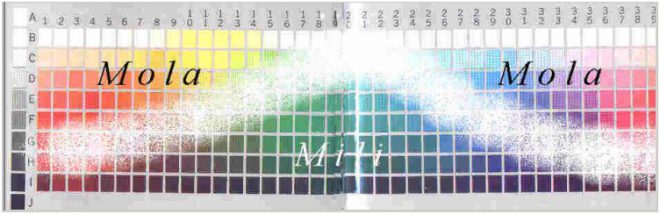
As a prelude to probing this, it’s a good idea to first get a clearer picture about the Berlin-Kay study’s methodology. The experiments were originally designed as testbeds for the notion of linguistic relativity: that each language accomplishes the coding of experience into sound in a unique and totally arbitrary way. (This is predisposed against any notion of universals, in other words.) The design focused upon basic color terminology and concentrated upon where the foci or most typical color referent was located within the color space. They employed the Munsell Color Chart system as a test stimuli, comprised of 331 different adjacent colored chips. They are arranged as follows: there are 40 equally spaced hues in the horizontal direction and 8 degrees of brightness in the vertical direction. All 320 of these colors are presented at maximum saturation. Additionally, on the left margin are 11 chips of neutral hue ranging from black to white. It looks like this:

First, basic color words were elicited from target language informants. This process is a matter of interviewing a sufficient number of native speakers to smooth over any opinion outliers. Each subject was then instructed to map both their conception of the central focus point (a single chip) and also the outer boundary extents for each basic color within the presented Munsell chart. Subsequent followups to both verify and amplify original results have refined the methodology and aimed at further eliminating any inherent experimental bias. The original study looked at 98 different languages but only applied more rigor to 20 of the target languages as its prime focus. Slightly overlapping and irregular color region maps were a common finding among individuals and across languages. The dots within the color regions of the map below indicate the average point where speakers within a certain language located that color term’s focus.

Sapir-Whorf Hypothesis and Debate
Berlin and Kay wrote in their original conclusion statement that the language system’s color lexicon does not affect the perceptual system in terms of color discrimination or colour similarity judgements. Instead, it is the perceptual system which restricts the language system, especially for color categorization. They further maintained that their results refuted linguistic relativism, which was the assumption of Edward Sapir and Benjamin-Lee Whorf, influential anthropologist/linguists who had advocated since the 1930s that the language system wields a strict and coercing influence upon concept formation and perception. Sapir was Whorf’s teacher and both were incredibly accomplished field linguists, especially Sapir who had done much work cataloging and understanding native North American languages undergoing the process of extinction. It was Whorf who pushed the relativist hypothesis most ardently however, as he outlived Sapir by several years. Whorf contended that an individual’s thoughts and actions are determined by the language (or languages) that individual speaks. There is a spectrum of ideologies regarding the relationship of language and thought in human culture, with a strongly deterministic version of Sapir-Whorf occupying one pole, and a slightly less stringent ‘relativism’ next to it (but still favoring language over thought as the key factor), and then universalism near the opposite pole which holds in the extreme, that thought can completely free itself from any sort of linguistic influence. Of course all interim gradients are possible.
Basic Color Term research is thought to strongly favor universalism in that it shows that the constraints which determine color naming are not linguistic ones but perceptual ones (which are then subject to being worked upon by concepts). Berlin and Kay argued that especially the existence of 11 (or 12) foci is a perceptual phenomenon, quite independent of the existence of a language system. The categories centered upon these focal points were interpreted as basic lexical designations for a set of universal semantic entities, thus accessible to all human perception and thought.
Whorf described his view as follows in a 1940 paper:
“We dissect nature along lines laid down by our native languages. The categories and types that we isolate from the world of phenomena we do not find there because they stare every observer in the face; on the contrary, the world is presented in a kaleidoscopic flux of impressions which has to be organized by our minds – and this means largely by the linguistic systems in our minds. We cut nature up, organize it into concepts, and ascribe significances as we do, largely because we are parties to an agreement to organize it in this way – an agreement that holds throughout our speech community and is codified in the patterns of our language.”
A universalist might well be comfortable with Whorf’s worldview up to and including the bit about needing to cut nature up and organize it conceptually. The sticky part comes after this, for rather than being bound by our unconscious language agreements in this organizing process, we might equally be able to consciously apply our thinking to it. And this thinking may supercede language. Blutner simplifies the whole matter in the form of two questions. (1) Does the number and the type of the basic color terms of a language determine how a subject sees/perceives the rainbow? If yes, we have Sapir-Whorf’s linguistic relativism. Berlin-Kay’s answer would be no, almost no influence. (2) Is some natural system of basic color terms possible for any (conceivable) decomposition of the spectrum of the rainbow? Sapir-Whorf would say yes, because language is entirely arbitrary. Berlin-Kay would answer no, because there exist strict universal constraints, within which languages are constructed.

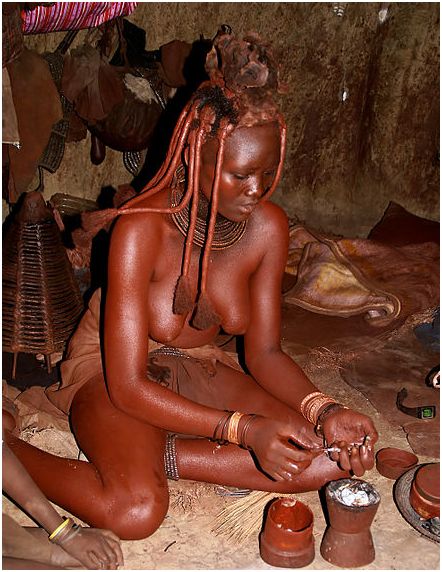

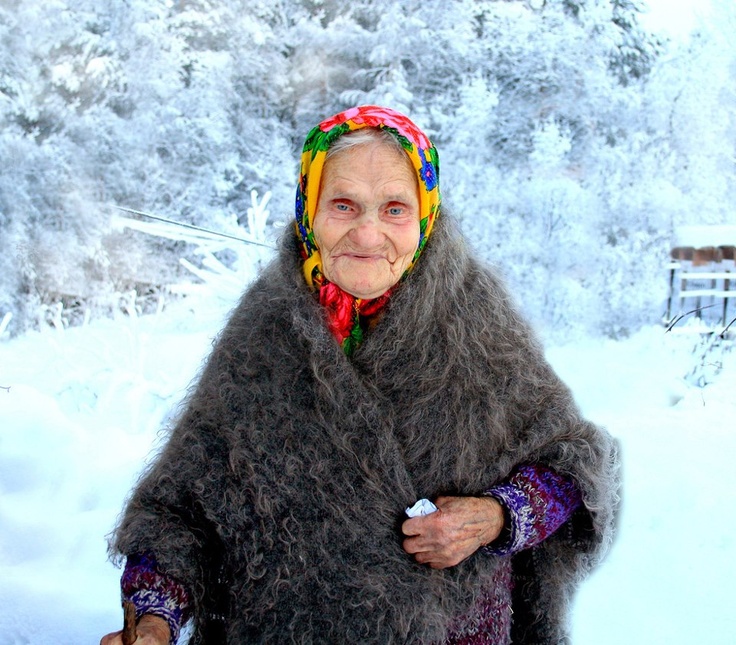
[ The dude on the left, aside from being a formidable looking war chieftain, is a speaker of Dani from Papua New Guinea, a 2-BCT language; the young lady just finishing applying a thick layer of herbal beauty and anti-deodorant paste lives in remote Northern Namibia and speaks Himba, a 4-BCT langauge; next, an Israeli scholar inspecting old Hebrew scrolls; finally the oldest resident of Karelia in northwest Russia; Hebrew and Russian are 12-BCT languages. ]
It should be noted that the universalist, in denying semantic arbitrariness, inherits the responsibility of developing some mechanism which explains the production of linguistic universals, and this subject is indeed active among current philosophers of mind and theoretical linguists. There are three basic options in play. There could be a strictly biological process along the lines of Chomsky’s posited LAD (language acquisition device), which deflects deeper inquiry towards (hopefully) coming advances in neuroscience. Or the whole explanation may eventually unfurl within the arena of social processes and reinforcement, as advocated by Grice. Or it might be down to an interaction between biological and sociolinguistic processes, with LAD effects and social influences looping and spiraling around each other.
Regardless of where one’s intellectual leanings lie upon the determinism-relativism-universalism scale, it is still an open question as to what the effects actually are, if any, of a language’s BCT set upon the inner world of it’s speakers. It may come down to individual variations in the degree of independent strenuous thinking a person applies both during speaking and not. This is the tip of an iceberg, an iceberg whose dimensions one can contemplate by carefully considering what ardent poets must have to do in order to stretch language convention in novel ways to permit them to convey the uniquely individual reach of their independent thinking.
_______RS
Notes:
1) A telling meme skirmish concerning ‘wide consensus’ for BCTs: Recently a twitter storm erupted over thousands of dearly-held opinions as to the boundary line, in English, between yellow and green. Specifically, are conventional tennis balls yellow or green? Would you believe the results actually hovered around 50-50!? Here’s the original twitter storm and here’s an Atlantic science article mulling over the mess.
2) Linguistic anthropologists have said some interesting things about warm and cool shades in general. This short article introduces some ideas.
If interested, you can read a different Linguistics-oriented post from the days when such matters fascinated me here, which is more oriented towards speech sounds rather than vocabulary.
► Handy INDEX — scan through all available ||SWR|| articles
 ||skirmishes|| ||with|| ||reality||
There is no generic Russian word for ‘blue’!
Whaaaaaaa! Super interesting stuff!
Yeah, that fact blew my mind too when I learned about it. Glad it appeals to you, Bree. 🙂
What a fascinating and in-depth topic you present to us. There is an artist in u who would be more appreciative of colors than most of us.
And I am afraid to confess I was impatient just deciding out which shade of white paint would best coordinate my kitchen walls with the floor. Took much time as the choices of shades are numerous. But I didn’t want to live with regrets.
I have always been fascinated with colors of people’s eyes. Of course, everyone disagrees on hazel as even those shades can vary subjectively. and im amazed at all the shades of blue, brown and green and while most ppl dont try to give them specific names, I do. I have a sweet relative who has teal eyes and she doesn’t agree with my label for them.
In my culture we often identify others – and even affectionately call them – by their skin tone. Dark brown people are called (by close kin) by Prieta/o but tho medium brown ppl are morenos, they arent addressed with that name. Lighter skin folks are gueros and yep, there is a family friend called Guera & Some of us dont even know her actual name. Guerita is another of my nicknames that my mom uses.
And yes, we argue about who is prieto or a lighter moreno. I have yet to hear that type of discussion amongst Anglos. Lol – is he pale white or crystal white? Haha! 😊 maybe anemic white? 😀
Personally, I wish manufacturers of textiles would learn these color diffrences better. I ordered a burgundy table runner and received a dark red. Not a tint of pink in it. Bleh. I guess I want everyone to know and agree upon what burgundy looks like.
I did do a study of best colors for people to wear, based on their skin tone and hair color. It paid for itself as I can now wisely purchase garments that are best for me & my loved ones. But it makes me more of a critical observer and I find myself cringing when I see someone who has spent good money on the wrong purchase.
I have also analyzed what feng shui colors suit my mood, and am shocked at what others choose. I have a friend who recently told me that her daughter painted the kitchen in black and everything else is black too. I must ask to see photos!!
And my brother painted my mom’s window-less kitchen an odd shade of orange and yrs later, I still get shocked when I walk in there.
I am sure ur savvy about how colors affect our minds. Someday I need to write to paper plate manufacturers cuz they r clueless about which colors stimulate the appetite.
Fun topic!
Many interesting things you write to respond to… I did notice and like, during my year living in Mexico, that everywhere there were golden yellows, oranges, and fiery or sometimes burnt reds in use, both for exterior and interiors of buildings. I had an orangey yellow hotel room once and the place lit up vibrantly at sunset through the windows. The wooden bed was enormous and heavy and so high that I practically needed to throw myself onto it in oder to sleep. Comfy as hell though. The stuff you say about burgundy got me thinking especially. Perfect example of why it is not a BCT color in English. People cannot agree what hue it is. I think marketers half the time just select the word cause it sounds good. You said not enough pink. I asked my PC about burgundy and it said, or rather the AI regurgitated, that whereas burgundy is red mixed with some purple, maroon is red mixed with some brown. And they are often confused. There is no consensus, language-wise. though some people have tried to force a standard, like with computer screen pixels, but that is after all just a team of ‘experts’ trying to enforce a standard out of their own opinions. The other thing PC told was that the color name originated from the particular color of wine grown in Burgundy province in France. But even this is subjective. When sunlight passes through the glass it reveals some pinks, but when not it is dark and mysterious. https://skirmisheswithreality.wordpress.com/wp-content/uploads/2025/01/burgundy.png
Your mention of studying clothing and skin pairings is intriguing to me, and I am quite curious to know which colors you’ve decided goes well for your complexion. My son is medium dark skinned from sub-Saharan Africa, and I notice that he looks fabulous in practically any bright colored clothing, though it is a battle to get him to not wear blacks and reds exclusively. Pre-teens! 🙂
Thank you for researching burgundy for me. I didnt know that it had purples in it & that would explain the pink tint that i believe exists in my version of burgundy. And also that you bothered to look up maroon. Didnt have a clue that it had brown. I agree that i find it difficult to differentiate between the two. — As for my colors, I am identified as the color winter. Winter people wear certain colors. Summers wear others, as do Autumn and Spring. I would have to guess that your son is probably a winter.
hmmm. affiliated with seasons. ok, thanks.
not seasons of the year but i think someone had to label these fashion group types with something people could understand. For example, winters ppl can wear dark colors better than spring or summer folks.
Wow..a whole study on color, thorough and categorized. I live in Costa Rica. I see green as parrot green as the leaves semi camouflage my own parrot in the tree:)
wow… that’s a pretty vivid green as I recall. 🙂 thanks for reading.
My pleasure, although Moroccan blue is my favorite shade of them all:)