
Apologies in advance, but against my better judgement sometimes, I feel impelled to indicate how repulsive certain holier-than-thou religious blog posts make me feel. How many blows on their noggins does it require to wake up to the message that we should be, above all, entered into an era of social and spiritual tolerance by now? Above all we should be respectful of individualized spiritual pathways…
1) A Response to R. Stroud concerning William Blake (1757-1827)
William Blake, for the uninitiated, was a visionary poet and artist who illustrated his written works by hand engraving them. He is a unique and leading English literary figure of the 18th century who foresaw the devil’s hook concealed within the burgeoning promise of modernism and attempted to counter-balance it with a creative dose of Romanticism. One needn’t dig very far to uncover Blake’s own self-assessment as to his Christian sentiments, shown by this account of his deathbed scene from Wikipedia:
At six that evening, after promising his wife that he would be with her always, Blake died. Gilchrist reports that a female lodger in the house, present at his expiration, said, “I have been at the death, not of a man, but of a blessed angel.“
George Richmond gives the following account of Blake’s death in a letter to Samuel Palmer:
“He died … in a most glorious manner. He said He was going to that Country he had all His life wished to see & expressed Himself Happy, hoping for Salvation through Jesus Christ – Just before he died His Countenance became fair. His eyes Brighten’d and he burst out Singing of the things he saw in Heaven.”
Yet here is pastor/blogger R. Stroud blithely dismissing Blake as ‘not a Christian’, while admitting to only a partial acquaintance or even interest with his poetry. An inquiring mind is forced to wonder: where exactly are the justifications for R. Stroud’s assessments coming from? Two places, as far as I can tell. First, he gathers that C.S. Lewis (whose opinions Stroud seems to take as secondary gospel) is wary of Blake and not exactly on board with his religious bonafides. And second, likely even more the core of the matter, he is troubled and suspicious of Blake’s utter disinterest in Stroud’s own brand of orthodoxy. I have long been mystified by a dogmatic fear and puzzlement on the part of confessional orthodoxy advocacy types regarding the strictly narrow range of which thoughts they deem acceptable to Christ, along with their sheer un-Christian gumption (in my view) to proclamate so to the world.
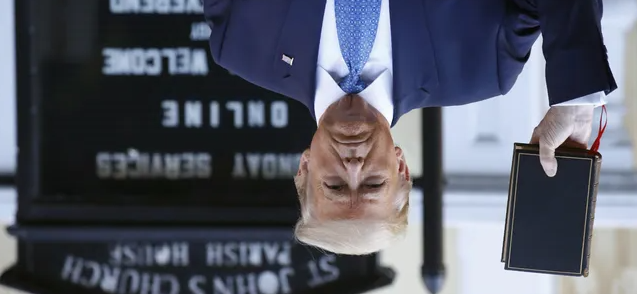
Now, as far as public intellectual argument goes, and aside from blatantly obvious instances of theatrical horse manure like depicted in the illustration atop this post, I try and religiously (*sic*) refrain from making such pronouncements, although I will always call out false certainty. Yet when I read Blake and look upon his drawings and other creative output, I am left with the impression of a deeply striving Christian-oriented individual. Striving I say. Because who in reality has actually achieved the status of becoming truly and absolutely Christian as of this moment? Is that not a future and gradual ideal for humanity? Have the charity of modesty! Think more on your own ‘sins’ and less upon those of others.
Stroud is careful to include some of C.S. Lewis’ praise for the literary quality of Blake’s output, and he also allows that much of the mythical subject matter for Blake’s work is derived from Biblical themes. But when it comes time for his money judgement he is very clear right at the outset: “Is Blake Christian? I think not.” Don’t take my word for it however — please have a look at the sanctimony for yourself.
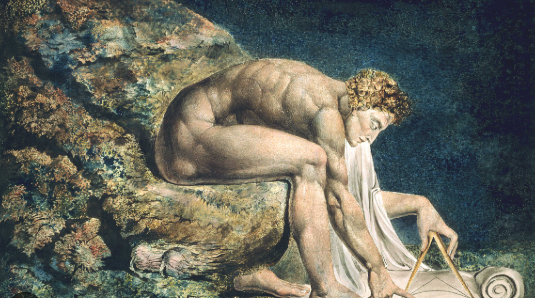
Blake’s 1795 depiction of seminal mathematician Sir Isaac Newton.
2) General Thoughts on Spiritual Freedom
Why and how is it that we are here? Where did everything come from, and what is our ultimate destination? Or even our short-term destination? How can we possibly reconcile the mystery of morality and conscience with external nature as sensorily observed? Why is there a disconnect between science and inner questioning (which has been associated with religion) in modern culture which simply was not there during the Dark Ages? Or in ancient Egypt? That these kinds of questions are not answered or even properly addressed by the doctrines one finds in Lutheranism, Episcopelianism, the Catholic Church, or Evangelicalism in general is recognized as inwardly apparent to anyone who conducts any kind of serious inquiry into the matter(s). That science is equally insufficient to grapple with these questions but merely provides cover for intellectually-inclined sorts to place them aside and assiduously avoid further introspection is also evident to contemporaries with enough honesty and sensitivity. So where are we, short term? We have outgrown traditional religion in the sense that it imposes a taboo against real questioning with a barricade of orthodox dogma. We have outgrown traditional science because it has dawned upon our more intuitive perceptions that although it permits questioning at a purely physicalist level, it also imposes a structural taboo against any sort of inquiry not having a clear relationship to measurable, weighable, countable and observable matter. In other words, anything we experience as most deeply human.
We are at a unique and special moment, collectively. We are left to our own devices to erect a path for which conventional religion and conventional science provide little relevancy. A new grappling with reality, a striving towards a next-level perception and articulation of truth. It does not mean that religions need be eliminated. It is more the case that the original revelations have to be individually examined for inspiration and understanding without the filters of imposed confessional dogma. Also, the reality of potential new revelations needs to be taken seriously. On the science front, it does not mean that all past results have to be toileted. But here again, any hint of authoritarianism and dogma must be rigorously resisted. Part of the scientific training must include a thorough individualized re-examination of the assumptions and founding principles of what science is and how it is conducted and what is allowed to be grist for its mill and what is not — and why all of this is inherently biased and limited. (A separate topic!) A new kind of re-marrying of science and spiritual inquiry needs to be midwifed, and it must be done out of human social needs, not simply cold pragmatism. It would need to include something like the following. All spiritual steps and insights taken must be inwardly subjected to a rational and logical examination for clarity and plausibility and implication. (The analytic part of science — not the materialism part.) And all scientific steps must be reconciled to human social needs and harmonized with spiritual and moral intuitions about truth. All advances must be looked at from the angle of subjective impact. In this way, these two naturally human endeavors can gradually overcome their artificial split and become one unified form of cognition.
An obvious consequence of all this is that a pre-requisite for even beginning to envision walking such a path would be for dogmatic pastors of specific religious confessions to refrain from broadcasting how individualized creative spiritual inquirists, like William Blake, fail to merit salvation or meet their narrow standards.
_______RS
► Handy INDEX — scan through all available ||SWR|| articles


Excellent essay on these conflicts I’d been experiencing myself. And oh how we need wise leaders to show us the way to understanding, accepting and adapting. The flock is scattered and brays in multi-confusion, and the world is not a peaceful place to co-exist with our brethren. — thank u so much! — Now how to disseminate your wisdom?
LikeLiked by 2 people
Thanks as always Steph. Not sure my first instinct would be to look for wise leaders on this, however.
LikeLiked by 1 person
Yes, and dont remind me of that optimistic desire because deep down I’m not sure they exist.
LikeLiked by 1 person
Si.
LikeLike
Sorry you’re so offended by orthodox Christianity. I don’t pretend to, or desire to, stand outside the Christian church’s consensus as expressed in the ecumenical creeds.
You are certainly free, of course, to believe that other roads lead to eternal life, or immortality if you desire, but I make it very clear that Mere Inkling is written from the perspective of historic Trinitarian Christianity.
LikeLiked by 2 people
Is that the extent then, of your insight, conscience, and sensitivity about this matter? I mean, an interlocutor points out that a wonderful writer and artist whom you deigned to publicly designate as not Christian actually professed deeply visceral Christian feelings while dying, and instead of re-investigating your opinions you pretend sorrow that I am offended by religious orthodoxy? That’s the best you got? I am not offended as such. I think it is wrong and misguided and imposes barriers and narrowed thinking on the flock which need to be removed. And this belief of mine is re-doubled when the pastor of such a flock, by virtue of your response, either fails to grasp the point I am making or pretends to and sidesteps it.
The thing which matters here is not whether your site makes clear that is ecumenically-aligned or that you do not intend or desire to go outside the boundaries of this landscape as you yourself interpret them. The issue is that someone setting themself up as an authority makes condemnations about figures in history about whom they admit to have only a superficial understanding and then refuse to look at direct evidence which counters their pronouncements.
LikeLiked by 1 person