
A talented, inventive Britsh folk-rock band who peaked in the early 70’s called Pentangle, and who loved delving deeply into centuries-pld folklore to uncover material to interpret…
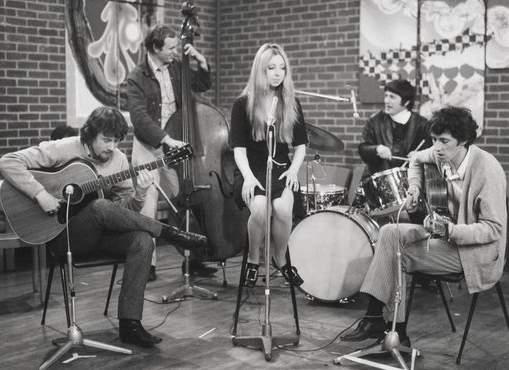
So named because of their five eclectic members, Pentangle occupied a key place in the British folk revival movement which seemed to flourish in England, Scotland, and Ireland as a kind of admiring echo of the American protest/folk music generation triggered by Phil Ochs, Pete Seeger, and Bob Dylan. Except that instead of rural Americana as the powering theme, in Britain inspiration was drawn from 900 rich years of legend and folk traditions. These musicians, it seemed, spent all their waking hours not occupied by practicing and sleeping in remote research libraries digging into folk tales from before the Renaissance. They don’t come off as erudite though, but very earthy and entertaining. Their instrumentation is largely acoustic although the lead guitarist occasionally steps on an effects pedal eliciting a great fuzz distortion sound. The drummer spends half his time using hands and brushes in place of drumsticks producing frisky rhythms and also doubles on a glockenspiel. The bass guy uses an acoustic stand-up double bass, and has an obvious jazz background. They also worked sitar and banjo in there at odd moments, and in very atypical playing styles. I loved this band, which a good friend introduced me to, and still today find them excellent.
First up is a live version of “Hunting Song” which they introduced as a sort of ’13th century rock song’. I was enchanted by the meandering introductory glockenspiel melody, and soon after many other textures enter into the musical passage. The lyric deals with a magic hunting horn of silver which carries the dangerous ability of revealing falsehood by spilling liquid upon any untrue persons who sip from it. A mysterious noble maiden is carrying it in the wilds to King Arthur’s court when a smitten knight happens by and begs her to allow him to deliver it for her. She agrees but misadventures follow. If curious to try and puzzle through the verses, check here.
The second tune, “Light Flight” from their 1969 album Basket Of Light, is jaunty and upbeat compared to the haunting refinement of the first song. The group actually was contracted to compose it as a theme song for a short-lived British TV ‘dramedy’ detailing the lives of three young working women in London. It’s amazing how rich and varied are the sound dynamics the group conjures out of simply acoustic instrumentation for this piece. The stand-up bass and soft-headed drumsticks the percussionist uses really make this tune pop with the female signer’s voice and the catchy interplay of the two guitars. The group was nearing the zenith of its popular appeal at this time, which they handled admirably well considering how at the core they were really distant from mainstream.
Stretching their versatility even further, this mostly acapella reworking of a medieval poem/hymn in Middle English is a true stand out. The words describe the journey path, quite involuntary, that a newly dead soul must take through the trials of purgatory and onwards. The lines which go “When from hence away thou paste/Every nighte and alle/To Whinny-muir thou comest at laste/And Christe receive thye saule/” refer to the Whinny-Muirs, literally a vast waste moor of thorn bushes and thickets which figuratively prick at the soul until it experiences vividly the suffering it has inflicted upon others during the just ended life. A beautiful and poignant funeral ritual dirge.
If ever thou gav’st meat or drink,
Every nighte and alle,
The fire sall never make thee shrink;
And Christe receive thy saule.
If meat or drink thou ne’er gav’st nane,
Every nighte and alle,
The fire will burn thee to the bare bane
And Christe receive thye saule.
If by chance still, like me, you are nowhere near wearied of this music, then I leave you with “Jack Orion” from their 1972 album titled Cruel Sister. This piece is an 18-minute tour de force rotating through many little musical settings to depict the the 16th century tale of a near magical itinerant fiddle player whose music: “… could fiddle poor fish out of salt water/Or water from a marble stone/Or pour milk out of a maiden’s breast/Though baby she’d got none.” It tells how Jack manages to charm the heart of a princess who invites him as an esteemed discreet guest to her bower three hours before the sunrise. But as with so many dark-toned myths of the British Isles, subterfuge and tragedy ensues. The band is at the height of their musicianship and arranging in this recording. Glockenspiel, recorders and a fuzz electric guitar color the texture. If you want to follow the lyrics, here they are.
(Then Jack Orion swore a bloody oath/By oak and ash and bitter thorn/Saying, “Lady, I never was in your house/Since the day that I was born.)
_______RS
► Handy INDEX — scan through all available ||SWR|| articles

