
Other night I decided to mess with an AI research agent to see what kind of details it could point me towards concerning wampum, a goofy-corny childhood play term we used to use. Actually, it was a reverential term in the native American language of the tribes local to my formative region, coastal and inland New Jersey. These people called themselves “Lenapi”.
(NOTE: This post forms a kind of sequel, from an alternate perspective, to last week’s more philosophical post of mine about how money as an idea is metastisizing within the compromised vigor of the body social.)
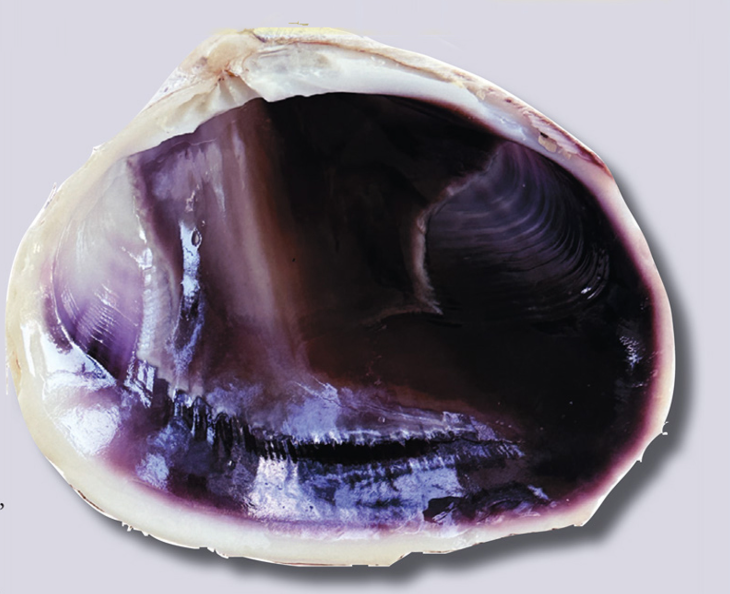
Consider the image above, with its gorgeous, completely natural yet mysterious purple color, and the feelings it prompts for a pre-modern soul. This is the inside of a kind of clam shell, known as quahog, common (far more so six centuries ago) to the New Jersey and Long Island barrier reefs. It was a prized item for the native peoples before Columbus, up to eastern Massachussetts and down to northern Delaware. Not just for the clam food. Uniquely for the Lenapi and close-by related tribes, this natural artifact became highly valued when crafted and worked upon, as a means of exchange, a rudimentary currency.
Sacred Purple
Now, hold that imagination and all it signifies and contrast it for a moment with the image of a Bitcoin. In truth, I really shouldn’t say “a bitcoin” because that nominalization falsely encourages one to picture that crypto money is more of a physical reality than it is. It is really a theoretical abstraction, and by far the vast percentage of people who own and use them have almost zero conception of what a bitcoin even is or why and how it works.
What attracts contemporaries to Bitcoin and similar crypto-currencies are things like: possibility of sudden absurd ascents in value completely unrelated to general economic factors, shielding from government or corporate oversight, excessive transactional anonymity — even in hindsight, capability for illegal purchases (for some) without scrutiny, and relatively simple conversion with everyday money. Not an especially socially-minded suite of motivations.

What initially seeded the Lenapi devotion to the interior of the quahog shell was the beautiful purplish color and sheen of the material, which took the role of a living natural symbol for all that was concealed, exalted, mysterious, and spiritually just beyond reach in their earthly paradise. An element of devotion and worship and value-consciousness beyond the merely material colored the Lenapi conception about this currency. And its transactions were human, social, direct, and non-abstracted. Further, crafted articles from quahog shell interiors were used to signify persons of special honor or dignity. Beauty as an ideal was not so separated from currency as it has become in modern times.
Money Is Communal, Therefore Sacred
Cahokia, or something similarly pronounced, was the name of a great mound culture “city” of an estimated 12,000 people in the area of what is now southern Illinois peaking about 1000 to 800 years ago. It was a cultural and trading hub among other things, and stood near the Mississippi River. The distance from Cahokia to Atlantic City (ignoring the anachronism) was about 950 miles. Experts doubt, according to academic orthodoxy, that anyone ever walked from one place to the other in their Native American lifetime. There would have been numerous tribal territories, langauge barriers, geographic changes, food customs, weapon concepts, and mythology conventions to navigate. To say nothing of the likely occasional hostilities. Starting in the east, at the ocean, for example, one soon would have come to the current state of Pennsylvania which was basically one enormous dense 300-mile-wide forest. Yet, in far Cahokia, Lenapi shell bead wampum sticks were known, revered, and accepted for exchange.
Here is how one researcher eloquently describes the role of wampum within Eastern Amerindian societies: (my bold highlighting)
“Historically, wampum has played a central role in diplomacy, governance, and social structure. It was used to mark agreements, record treaties, and acknowledge significant events. Long before European arrival, wampum belts served as living records with each bead, color, and pattern carrying a specific meaning. These belts were spoken into being during public gatherings, where words and wampum together affirmed the shared memory of what had been agreed upon. The physical belt served as a document, but it was the spoken words that activated its meaning, binding people to their promises in both memory and material. For the Wampanoag and other Indigenous Nations across the Northeast, wampum carried the weight of law and the responsibilities of relationships.”
The Corruption Of Human Exchange
So, in place of what eventually became an economic ledger and dry complex spreadsheets, they had an artistic, physical artifact suffused with reverence and meaning and an accompanying lore-memory. Important transactions were ritualized; everyday personal ones were respected and never trivialized. At present the propriety of transactions are assessed entirely upon whether or not the funds are physically or electronically available. It is a simple web-mediated pass/fail question. Yes or no. The reasons why something does not receive electronic verification have no importance, and are not to be considered. No personal judging takes place, and transactions carry less and less feelings of individualized interaction. We do not know the interlocutor and do not want to know anything about them. Character is completely irrelevant, as is trust. With crypto this descent from human connection within economic activity extends further to absurd levels. Blockchain records only carry indecipherable codes from which not even the identity of the transaction participants can be learnt. Only the dollar amount is readable. And the pace of change is so quick that the next generation might have no concept anymore about what a human exchange even feels like.
Take note also of the idea of “speaking an exchange into being” as highlighted in the above quote. See how deeply respected human speech was. A quasi-spiritual act which caused some new truth to come into existence, creating a lasting bond between the participants.
The Root Of Evil?
One way of thinking about our possible future, employing outside-the-box concepts to eradicate the despicably uneven distribution of wealth in modern society, is to re-examine the contrast or relationship between work and money. An author I once read, but can’t find at the moment, put this juxtaposition succinctly, in stark but thought-provoking terms. He described human labor for a paragraph or so, portraying it as a beautiful divine creative gift-like act, consciously emanating from the individual’s entire engaged being while meditatively aware of it’s importance for the social community at large. Then he tied this selfless loving description of labor with a bow: likening it to Christ energy. Then he spent a new paragraph describing the contemporary idea of payment for human work, using all it entails on a spiritual level as described in the ‘legend’ recounted in my recent economics-oriented post. He similarly tied this concept with a bow, likening it to Satan. Then he described the obvious esoteric meaning of working for money: Someone gives out Christ from his or her own being. And in exchange for this, we compensate him or her with Satan.
This is a meditative picture worth dwelling upon. And we must begin by infusing all of our purchases with a more mindful gratitude. We have moved from the devotional community-conscious mindset of the Lenapi quahog craftsperson to the egotistical self-serving madness of technical financial manipulations, valuing only the margin of acquisition. Wall Street, NYC. Perhaps a day’s walk from the ancient quahog clam’s beach.
_______RS
[ Image : the glistening interior of a quahog seashell, once absurdly common in present-day Long Island. The purple color was considered sacred. ]
► Handy INDEX — scan through all available ||SWR|| articles


The quahog is definitely very beautiful in its appearance.
LikeLiked by 2 people
Yup, love the color. Remember it from youthful beach walks, though not all of them bore as much or rich a purple as the example.
LikeLiked by 2 people