
True, it once was known as The Great Salt Lake, But now it’s just ‘okay’ or ‘so-so’ or ‘meh’. And with Trump’s petty penchant for trying to cram new, if hokey and unimaginative, geographic nomenclature down our economically thirsty throats, maybe this once spectacular inland sea has outlived, barely, its moniker. The following Google AI dialog highlights why…
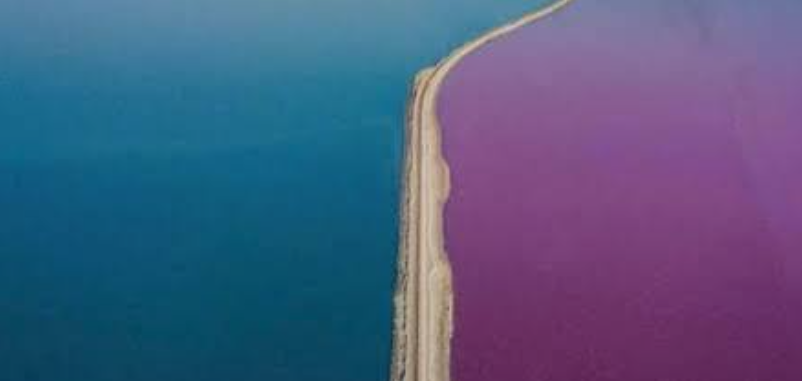
Will the real Great Salt Lake please stand up?
— Background —
Prehistorically, the GSL was a vast inland sea equal in area to about a third of the present day state of Utah, and in parts about 1500 feet deep. This, so the geologists surmise, was the story around 17000 B.C. when a recent Ice Age ended. But in historical times with modern climates the GSL only spanned about a tenth of that or perhaps 1800 square miles.
Things did not change much during the stewardship of the native Americans; the Shoshone, Utes, Goshute and Paiutes all used the area surrounding the lake in an ecologically harmonious manner albeit never for drinking. The lake had no outlet; it was only fed by inlets, namely mountain-fed rivers. These rivers would receive prodigious winter snowfall and the resulting springtime flow would replenish whatever naturally evaporated from the basin due to the dry very hot summers. Because there was no natural outflow, the dry season evaporations over time produced an excessively mineral-rich water, exceeding even the oceans in salinity. Besides using the surrounding marshy ecosystem for hunting ducks and eggs and mineral-rich herbal plants, the locals also harvested valuable salts for preserving bison and antelope meats.
Westerners first came in bulk in the form of a massive Mormon migration from Illinois and points east during the 1840s. About 70,000 settled at what became Salt Lake City on the shores of GSL, precipitated by religious persecutions and the murder of their ‘prophet’ Joseph Smith. Thus it was, by virtue of prophetic visions involving golden tablets and the angel Moroni in New York state that karma first infected Utah with a serious dosage of non-harmonious ecologically ignorant Western civilization. Not to imply that the Mormons were particularly culpable — certainly any sufficiently numerous exponent of modern industrial culture would do. The present day GSL covers about 800-900 square miles and that number is decreasing rapidly. The Wasatch Mtn. basin containing the main city and the satellites like Provo and Ogden houses close to three million residents now.
— Water Usage —
The time lapse video directly above, sourced from the Friends of Great Salt Lake website (recommended) shows the drastic change since only 1984 when some record snowfall caused a minor peak in GSL’s size. Obviously this is not a purely natural change over the past 30 years. Seeing is Believing. Except if one is a flat-earther type, or perhaps a Republican lawmaker or rural farm voter in the state of Utah.
The half-hour YT video below (‘Why Utah’s Great Salt Lake Is Dying’) gives convincing detail about what the man-made catastrophe is going to consist of and how extensive the economic fallout will be, as well as outlining the short-sighted economic rationale precipitating the crisis in the first place. But the straightforward water arithmetic is not complicated, and I will set down a basic summary right here.
The large areas to the west, south and north of GSL is a hot dry desert. Only a strip to the east contains the lofty mountain range whose springtime rivers feed their annual snowmelt into the great lake. Salt Lake City is sandwiched in between. Each year a certain amount of rainfall and snowmelt adds water to the lake’s coffers. Also each year a certain amount of intense desert evaporation removes water from the lake. In pre-modern times these two factors tended to even out. But the equation gradually changed with the advent of a modern population on the lake’s eastern shores. And this century, the 21st, sees that change accelerating at an unimaginable pace, which nature cannot withstand.
Further, the accelerating factors are getting worse, making the amount of evaporation about double the amount of annual precipitation at present. The acceleration is accelerating. For example, climate change is reducing the average amount of yearly snowfall in the Wasatch mountains. Also, the reduced volume of water within GSL is producing less vapor clouds in the sky moving east above the mountains, meaning less non-winter rainfall. The three main rivers which feed GSL and flow from the surrounding mountains are being increasingly tapped into, diverted, for civilization purposes. Two main consumers cause this: (1) nearby cities, and (2) agriculture. I was personally quite surprised to learn that the second factor significantly outpaces the first. Of the diverted annual water volume, roughly 78% goes to Utah farmers and about 20% goes to supply urban consumption!
What are Utah farmers up to, you might ask? I did, and was again surprised to learn that the huge majority of diverted water for agriculture is because of one single crop. A monoculture: alfalfa! Now in life, maybe, stretching it, I have probably eaten a few hundred alfalfa sprouts from various health food stores over the years when in an exotic mood, in a salad with some sort of vinagrette lime tahini sauce dressing. Really, who consumes all this alfalfa? The answer is dairy and beef cattle. Dairy farmers and Cattle herders across the West, not all of them located in Utah necessarily, are responsible for consuming the vast proportion of agriculturally diverted GSL inlet waters. And agriculture itself consumes the vast proportion of all diverted GSL inlet waters, even when compared to city water needs from places like Salt Lake City, Provo, and Ogden. Should we be thinking a little about revisiting the advisability of having about 14,400 high-end steakhouses in the USA? Incidentally, Texas and Florida, two staunch Republican voter strongholds, carry the two highest quantity of steakhouses among the US states, about 1300 each. Utah farmers also represent a staunchly Republican voter block. Utah lawmakers are rigidly opposed, as a group, to anything vaguely scented like water regulation legislation.
— Just The (AI) Facts —
A hobby or instinct of mine of late is to consult what some AI tool or other has to say about a fresh topic I am researching. GSL and its fate is a pretty new topic to me, so I gave an AI tool a listen. For reference sake, I don’t really come anywhere near to believing that AI tools are digital geniuses in a bottle. I think of them more like vast and swift synthesis tools against an endless agglomeration of purely human knowledge fragmented and re-sorted into trillions of pieces. I only asked two questions but received a wealth of info. Here is what I learned:
_________________________
…Beginning of AI Dialog…
_________________________
Does the Great Salt Lake still exist or has it dried up?
The Great Salt Lake still exists, but it is shrinking rapidly and facing a severe environmental crisis. [1] (https://www.hcn.org/articles/utah-is-killing-the-great-salt-lake/), [2] (https://svs.gsfc.nasa.gov/15020/)
Current State of the Lake
Massive Water Loss: The lake has lost roughly 73% of its water volume and 60% of its surface area compared to historical averages.
Shrinking Footprint: It has dropped from a historical average of over 3,000 square miles down to a fraction of that size, exposing hundreds of square miles of dry lakebed. [1] (https://www.youtube.com/shorts/qToV7UOrgiM), [2] (https://www.hcn.org/articles/utah-is-killing-the-great-salt-lake/)
Record Lows: Water levels hit a dangerous low point in 2022, and scientists warn the lake could largely disappear within years without major changes. [1] (https://www.nbcnews.com/science/environment/utah-refill-great-salt-lake-us-olympics-2034-rescue-project-rcna261422), [2] (https://pws.byu.edu/great-salt-lake)
Why the Lake is Shrinking
Upstream Diversions: About 80% of the water loss comes from rivers (like the Bear, Weber, and Jordan) being diverted upstream for agriculture and city use.
Agriculture Use: Farming —especially growing alfalfa— consumes the majority of the diverted water.
Climate Change: A warming climate increases evaporation rates, making the water deficit worse. [1] (https://www.youtube.com/watch?v=jq0FhcfAbG0), [2] (https://www.facebook.com/LTAmerica/videos/once-a-thriving-inland-sea-the-great-salt-lake-is-now-retreating-at-an-alarming-/1691625511894239/), [3] (https://www.hcn.org/articles/utah-is-killing-the-great-salt-lake/), [4] (https://www.youtube.com/watch?v=1cUKk4l6d20)
Risks and Dangers
Toxic Dust: As the lakebed dries out, it exposes dust laced with arsenic and heavy metals that winds can blow toward Salt Lake City.
Ecological Collapse: The shrinking water threatens millions of migratory birds and the global supply of brine shrimp. [1] (https://www.reddit.com/r/geography/comments/1ngvn0h/why_in_the_last_few_decades_there_has_been_a/), [2] (https://www.youtube.com/watch?v=1cUKk4l6d20), [3] (https://www.youtube.com/shorts/qToV7UOrgiM)
What proportion is due to the agricultural use, and what proportion for, as you have said, cities? And what is the alfalfa used for and by whom?
Human diversions are responsible for taking roughly 62% of the total river water that would naturally flow into the Great Salt Lake. [1] (https://www.sciencedirect.com/science/article/pii/S2667010024002312)
Water Diversion Proportions
Of the water diverted away from the lake by human activity, the breakdown is overwhelmingly dominated by farming: [1] (https://www.researchgate.net/figure/Water-depletions-in-the-Great-Salt-Lake-basin-based-on-1989-2022-averages-a-All_fig2_387144641), [2] (https://www.sciencedirect.com/science/article/pii/S2667010024002312)
Agriculture: Accounts for 71% of the diverted water.
Municipal & Industrial (Cities): Accounts for roughly 17% to 20% of the water (used for residential yards, drinking water, indoor use, and industrial operations), with the small remaining slice going to mineral extraction companies operating directly on the lake. [1] (https://insideclimatenews.org/news/07012025/to-save-the-great-salt-lake-farmers-will-have-to-grow-less-alfalfa/), [2] (https://greatsaltlakenews.org/latest-news/salt-lake-tribune/not-just-farms-new-report-shows-where-water-from-the-shrinking-great-salt-lake-is-going), [3] (https://www.sciencedirect.com/science/article/pii/S2667010024002312), [4] (https://www.researchgate.net/figure/Water-depletions-in-the-Great-Salt-Lake-basin-based-on-1989-2022-averages-a-All_fig2_387144641)
What is the Alfalfa Used For?
Of the 71% of water that goes to agriculture, 80% is used exclusively to grow livestock feed crops, primarily alfalfa and grass hay. [1] (https://www.sciencedirect.com/science/article/pii/S2667010024002312) Alfalfa is a highly nutritious, protein-rich legume used almost entirely as feed for beef and dairy cattle to support the production of meat, milk, cheese, and ice cream. It is incredibly water-intensive, requiring roughly 450,000 gallons of water to produce just one ton of alfalfa. [1] (https://www.instagram.com/reel/ClXrz–M-xO/), [2] (https://www.sltrib.com/news/environment/2026/05/31/utah-farmers-share-frustrations/), [3] (https://insideclimatenews.org/news/07012025/to-save-the-great-salt-lake-farmers-will-have-to-grow-less-alfalfa/)
Who Uses and Consumes This Alfalfa?
The alfalfa grown in the Great Salt Lake basin is utilized by two primary groups:
Domestic Farmers and Ranchers (Approx. 70%): The vast majority is used locally or within the United States by roughly 20,000 farmers and ranchers in the region to sustain around one million head of cattle. [1] (https://www.reddit.com/r/Utah/comments/1odvk44/74_of_great_salt_lake_water_diverted_to/), [2] (https://insideclimatenews.org/news/07012025/to-save-the-great-salt-lake-farmers-will-have-to-grow-less-alfalfa/)
International Markets (Approx. 29% to 30%): A massive portion of Utah’s alfalfa is dried, compressed, and exported overseas. The primary buyers are countries in Asia and the Middle East —chiefly China— which buy the hay to feed their own rapidly growing dairy and beef industries because they lack the domestic water resources to grow it themselves. [1] (https://www.instagram.com/reel/DY48U-vu_ZV/), [2] (https://insideclimatenews.org/news/07012025/to-save-the-great-salt-lake-farmers-will-have-to-grow-less-alfalfa/), [3] (https://www.reddit.com/r/Utah/comments/1odvk44/74_of_great_salt_lake_water_diverted_to/), [4] (https://www.instagram.com/reel/ClXrz–M-xO/)
_________________________
…End of AI Dialog…
_________________________
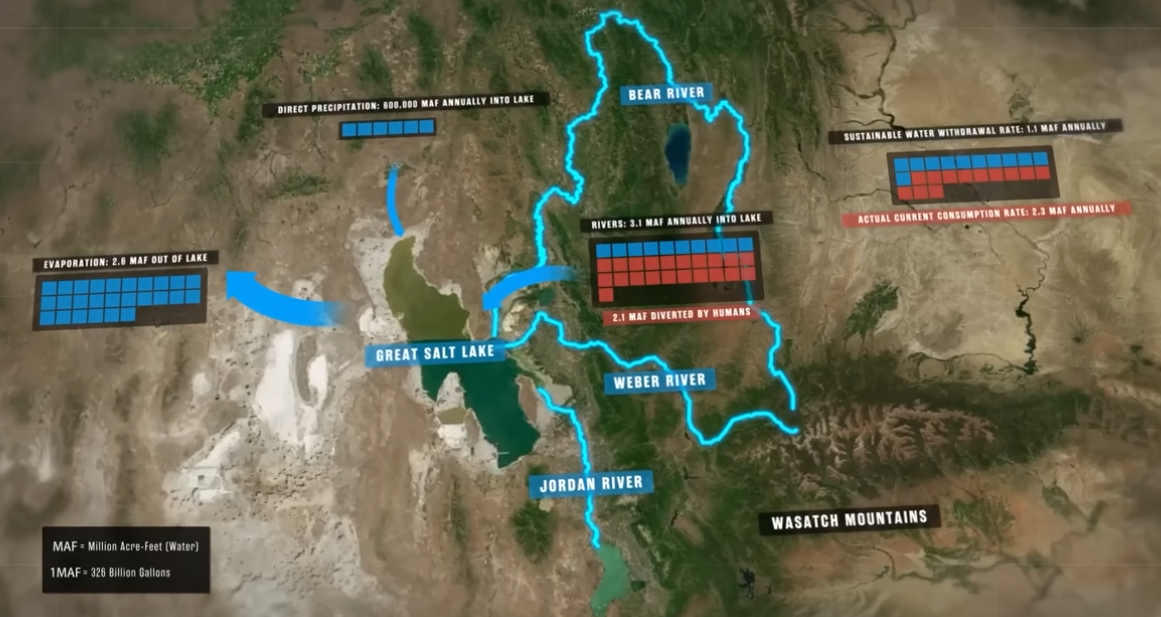
This image encapsulates GSL annual water math nicely. Zoom in for clarity. 1 MAF means a million acre-feet of water. Imagine a sheet of water wide as an acre and one foot deep. Each year: 600K of these come as rain; but 2600K naturally evaporates; if 2000K replenishes via river flow then all is good; in fact, 3100K flow in via the three rivers; but of that 2300K are diverted for cities and farming; this leaves a shortfall of 1200K per annum.
— Can The Natural Destruction Be Reversed? —
I don’t know. Clearly, the generic ethical solution direction is for individuals to realize that short-term personal advantage thinking is inherently immoral and eventually catastrophic as opposed to cultivating an openness to deeper thinking, and feeling (!) about the wider consequences — in the not too longterm really — of purely self-preservation decision making. Consequences even upon oneself if one’s life expectancy reaches another fifteen years or so. Unhappily, arrayed against this blatantly pragmatic truth is the reality of the prevalent “philosophy” which flows downwards, minus inspection, in conservative (the irony of the term!) spheres from the current leadership. Trump openly quotes to journalists and aides, for example, that it is stupid to care about climate change since by the time any serious shit arrives at the fan he will be deceased. Fecal matter attitudes flow downstream.
If the generic ethical solution direction, i.e. common sense, ever gains anything like a groundswell then great — there is hope. But there are some initiatives happening which do not depend upon this eventuality. Always a few visionaries move towards action. The leadership of the Mormon LDS (Latter-Day Saints), for example, despite their otherwise staunch political conservatism (80% of Utah lawmakers identify as LDS and 65% of citizens oppose water usage curbing regulations and 67% voted for Trump in the previous two elections) have been vocal in recent efforts to persuade the flock about the necessity for cutting water usage. They also have committed millions of late towards various local ecological initiatives. They kmow what will, what already is, happening to their Zion valley of redemption when the lake bed dries and the mineralized dust spreads across the basin containing arsenic and other toxic gasses. They also know what will happen to their famed prosperity when real estate values around Salt Lake City bottom out. The LDS Council has been shifting to portray water conservation as Mormon spiritual obligation. Then there are the activist groups sprouting to evangelize the reasonableness and vital nature for new broad collective conservation measures. Friends of GSL, previously mentioned, is but one example.
_______RS
[ Image : Northern (red) and southern (blue) portions of the Great Salt Lake in Utah, separated by a railroad causeway. The causeway prevents the waters to mingle and the southern side receives all the fresh water inflow from mountain rivers. Both sides are highly salty, but the northern side has far higher salinity and like a Ph strip acidity experiment it displays a deep red color. ]
► Handy INDEX — scan through all available ||SWR|| articles


I never saw the Great Salt Lake itself.
But my dad and I passed through Salt Lake City on a major highway that went through it on a bus tour trip down to Palm Springs California.
LikeLiked by 2 people
Yeah me either Drac. One of those places I was fascinated by in childhood and certain I’d happen upon one day. I hope it survives and thrives eventually.
LikeLiked by 2 people
Yes, I hope it does too.
LikeLiked by 1 person
Such a comprehensive discussion that argues convincingly that the Great Salt Lake needs serious attention. Immediately. But as you point out, Rob, that’s unlikely to happen for many reasons.
Salt Lake City doesn’t sound like a wise place to build a city in the first place, except, perhaps, for a small group of persecuted people who wanted a sanctuary. It’s rather surprising that few questioned the wisdom of expansion in an environment that clearly lacks access to fresh water for people, industries, and agriculture. I’m glad to see you have done such a thoughtful job raising these issues here in your post!
LikeLiked by 1 person
I got fascinated with the GSL situation while studying where the US trans-continental railroads met, east and west, originally. You may be right about Salt Lake City’s setting, though it seems pretty random where cities agglomerate in modern times, and these problems seem to happen all over the place. All that said, I still think a better job could have been done, and still can be, in terms of water diversion from the feeding rivers. Perhaps there is something to say for having a small team of resource geography experts make policy in this arena, instead of catch-as-catch-can market forces. I was also surprised to learn that a full 20% of the diverted water agricultural sales of cattle feed goes overseas mostly to China. That seems entirely un-thought-out to me. Thanks much for reading! 🙂
LikeLiked by 1 person