
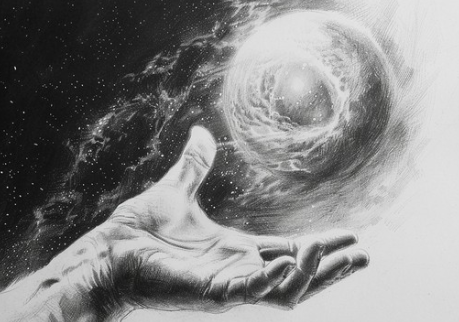
The scripts of human theater
Replete with many roles
But favorite parts are cloistered hearts
And crippled one-eyed souls.
No sin you have can scorch me
Or poison this well’s core,
My affection far too obstinate
To suffer the pathos du jour.
Yes or no we touch earth lips
Still I’ve known your longest kiss
And outwait all indifferent gods
For one caress of finger’s tips.
_______RS
[ Note : One of my favorite, most simple and beautiful lines from John’s Gospel… John 1:39 “Come and See…” ]
► Handy INDEX — scan through all available ||SWR|| articles


❤
LikeLiked by 2 people
🙏🙂❤
LikeLiked by 2 people
Since one point in my life there was no sin at all any more and so it is and will be because it is a human construct to manipulate humankinds mind body and soul in an immense manner
LikeLiked by 3 people
It is completely understandable that one would infer a religious tone to this little piece. The mention of gods and sin and even the reference to a gospel verse. But the reader who becomes fixed upon this facet is not seeing into the deeper meaning and intention, I can assure you. And though it is interesting you’ve had a certain belief or disbelief since a certain point in your life, that is a side matter since there is nothing religious within this poem. The poetic meaning of ‘sin’ being used here refers to the spectrum of unhealthy/healthy not forbidden/allowed or evil/good. And more importantly: the judgement or weighing about ‘sin’ in this case is being executed by the human participants in the drama, not some overseeing deity. For sure, you will admit that human pathology exists. And the reference to ‘gods’ is used more as a poetic reference to the machinery of destiny in our lives (along also with the “scripts of human drama”). Besides, that word points away from monotheism. Even the gospel line is of a completely general nature, holding up the merits of exiting the virtual world for the sheer excellence of empirical experience.
Thanks for your comment and I will soon make time to look through your interesting blogsite. 🙂
LikeLiked by 1 person
Thank you very much from the core of my heart for sharing your insights with me. When it comes to pathology, stante pede the term SALUTOGENESE and as well EMPRAXIS comes out of more than my mind. Destiny implies an external determination. Following one’s inner benevolent voice does not imply being negatively alienated because we ourselves are also stardust
Danke sehr fürs Interesse
May you first please take a look at the top left of the header on my blog. There are three horizontal lineswhich like give you a first impression in what belongs to my personality
within sympathetically greetings
LikeLiked by 2 people
Welcome. Well, let’s see… first off, I disagree that we are stardust. This is a very materialistic or physicalist concept and I think it is obviously wrong. It might take a while to hash out why though, and I am not sure it’s a great idea to conduct a heavily philosophical question within a blog commentary. I also do not agree that destiny implies exterior determination. I think the reverse mostly — it is caused by our own greater past if I may put it that way. Of course we are bound by externalities too… gravity exists, lions can beat us in a fight, nature is governed by laws, etc. There is a physical framework we all inhabit and it comes with constraints. If one thinks that framework was non-created then this implies that the physical nature of the cosmos externally determines us to a great degree. If not, then some higher intelligence may well have had a hand in designing and forseeing various constraints. Destiny as a term does not imply anything absolute or 100% unyielding (unfree) although peculiarly enough the stardust purely material concept does. For many scientist types materialism implies no free will. I see this as false by experience. Finally, about how you see pathology, it needs more exploration I think. If you mean Antonovski’s salutogenic proposals, it offers something yes, but still there is psychological work necessary in even coming to find that or choosing it. And there is the prior work necessary of recognizing, creating enough inner distance, to even see one’s pathology to decide to try to change it. So, ‘sin’ is real in that sense because error is real, and pathologies develop. And/Or are externally seeded by other’s inhumanity. The Empraxis idea has its place too — where would athletes and musicians be without it? But a mistake would be made if one takes it to the extreme that no reflection/introspection is needed, just accumulated muscle memories. That would equate humans with animals, much like Neo-Darwinism does. Which I also think is obviously false. PS — I wont get time for your site for a few days… lots to do here. Thanks!
LikeLiked by 2 people
Thanks a lot for your comment. All in all that’s profoundly very much for now as to resonate presently for me and as well as you I got lots to do here at me.
May ya feel welcomed on and in my site whenever you got time
LikeLiked by 1 person
Your clarification in the comments regarding ‘sin’ as a spectrum of health versus human pathology—rather than dogmatic judgment—was such a fascinating read! It really adds a deeper layer to the poem’s reflection on human drama. Beautiful piece, RS!
LikeLiked by 1 person
Thank you very much. And thanks for reading.
LikeLiked by 1 person
😊😊😊
LikeLiked by 1 person