
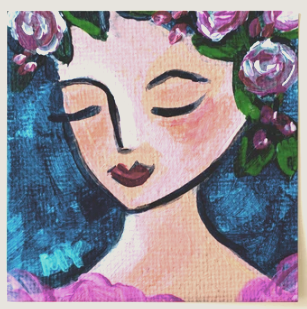
careful with that keyboard, human
lest your muse has beckoning cleavage
or her navel unravels your volition
intelligent demons operate nearby
alert in a twilight betwixt goodness and evil
a new ethos stalks its own birth
whence good and bad are obliterated
in their stead glisten ‘healthy’ and ‘unhealthy’
It’s objective; the muse needn’t be aware
careful with that keyboard, human
_______RS
[ Image : sample artwork from the 100 Muses Project, by Canadian artist Mili Santos — learn more here. I also discovered, while prepping this short piece and the next one, that a fragrance exists called ‘Muse In The Mist’, an apt name indeed. ]
► Handy INDEX — scan through all available ||SWR|| articles


Pathos ~ whether it pertains to an object, a person, or even a so-called muse ~ within the framework of ethos for which the individual is responsible, is more than an aspect.
Pathos is essentially pure holism
LikeLiked by 2 people
Let’s see if we can disentangle this rather obtuse remark…
First, pathos. You are either connoting according to the Greek or the modern vernacular. For Aristotle, Logos-Ethos-Pathos was a triumverate of persuasion tools within speaking or written discourse. In this context pathos meant using emotion in one’s arsenal or debate or rhetoric. (Not necessarily exclusively, just a toolbox item: certainly legit within poetry.) In modern parlance it hs more a meaning like ‘experienced suffering’. (The ultimate example I can think of being the Passion Of Christ, but you could think on the story from the Count of Monte Christo. Or the story of Job.) The fact that you relate it to ‘ethos’ makes me wonder maybe you are referring back to Aristotle. But maybe not.
Second, holism. Easier term to grasp, this one. In terms of pathology or alternative medicine ideals, it refers to the doctrine that the entire ‘system’ or organism must be considered to develop a true diagnostic picture around some malady. Including psyche, not just corporeal.
So, your statement means something like experienced suffering or emotional persuasion is an entirety, a feature of the whole (non-reductionist) system or thing. What thing? A muse? Or maybe the poet? I can agree about holism in general, but again not exclusively. You speak though of a framework: the framework of ethos for which the individual is responsible. First off, this is a little categorical in today’s human situation, because individuals are not 100% in existence yet. We are developing and unfolding and struggling. To be responsible means to be free of shades of subconscious influence. I never met such an individual, so I try not to think so categorically. Thus I wrote, an ethos striving to be born…
Poetry is not logical discourse. It is (potentially) higher than that because it tries to unveil ‘holism’ about something which is not immediately evident or graspable. In Aristotle’s meaning, the ethos ingredient of his trio is something like poetry: the individuality straining to express itself to locate truths beyond the ken of reason and logic.
In my post, the poet must choose the muse, but the muse courts the poet. And aspects of this are subconscious. The poetics tries to gradually untangle the ambiguities but also seeks to find and express beautiful new ones. The element of sexuality within the muse concept is a two-edged sword. The poet must find the balance without rejecting the muse. The muse is an aspect of destiny for the poet.
LikeLiked by 1 person
In deinem Kommentar redet mir ein viel zu viel denkendes Hirn das sich nicht auf sich selbst besinnt. Meiner Wahrnehmung nach spricht da kein Herz und auch kein Bauchgefühl sondern nur vernünftiges Wissen ohne Gefühl.
A person’s feelings ~ essentially are the very core of all human beings and that is, in a way of as near as possible, how to ally with.
And now, my friend, I’m shaking off all those words and switching in to my feelings.
LikeLiked by 1 person
No, actually they don’t sound like that at all. Your initial comment was so obtuse that it required some thinking to penetrate. Or, I could have just ignored it, but chose not to. Next time I might. Also, feelings are not more core than thinking, or willing. They are a holism, these three. You needn’t “switch one off” to delve into another. Although you might be into that habit, of course.
LikeLiked by 1 person
Excellent and wise poetic advice, my friend, as a lot of my muses do seem to have beckoning cleavage.
LikeLiked by 2 people
🙂 Not all that terrible a problem to have 🙂 Merci.
LikeLiked by 1 person
C’est vrai.
LikeLiked by 1 person